

A Saturday That Says Something
I hear versions of this regularly.
A woman spends Saturday “catching up.”
Emails while folding laundry.
A productivity podcast in the car.
A quick stop at Town & Country Market that somehow becomes six errands.
Then she reorganizes a closet she doesn’t particularly care about because apparently this is what Saturday has become.
At 9 p.m., she finally sits down.
And almost immediately, she feels uncomfortable.
There are still things she could be doing.
Am I burned out, or am I just really bad at relaxing?
It’s a reasonable question.
A lot of high-functioning women don’t recognize how exhausted they are because they’ve become very good at functioning while exhausted.
Things keep getting done, so they assume they must still be doing okay.
But functioning and feeling okay aren’t the same thing.
And when exhaustion, anxiety, irritability, brain fog, guilt, and the inability to relax start showing up together, it can be surprisingly difficult to tell what’s going on.
First, What Do We Mean by Burnout?
We use the word burnout pretty broadly.
People talk about work burnout, parenting burnout, caregiver burnout, and sometimes just being burned out by life.
When I was talking with my brother, who is a physician in Germany, about burnout, he mentioned that burnout syndrome is a familiar term in German medical practice. That caught my attention.
In the United States, burnout is not a mental health diagnosis. In Germany, burnout can appear in medical coding as Burn-out under a category related to difficulties in coping with life, but it is not classified as an independent psychiatric disorder.
The World Health Organization takes a similarly narrow approach. In ICD-11, burnout is an occupational phenomenon—not a medical condition or mental disorder—associated specifically with chronic workplace stress that has not been successfully managed.
Researchers also study experiences outside the workplace, including parental burnout.
So we have a word used broadly in everyday life, somewhat differently across healthcare systems, and more narrowly in formal classification.
Very convenient.
Real life, of course, doesn’t divide itself nearly that neatly.
A woman can be managing a demanding job, raising children, caring for an aging parent, maintaining relationships, tracking a household, and trying to remember when she last scheduled a mammogram.
All of those demands arrive in the same twenty-four-hour day.
So when I use burnout more broadly here, I’m talking about the experience many women mean when they say:
I’m exhausted. I’m still functioning. But I can’t keep doing everything like this.
Anxiety and Burnout Can Happen at the Same Time
Anxiety and burnout share a lot of territory: poor sleep, difficulty concentrating, irritability, exhaustion, feeling overwhelmed, and trouble relaxing.
And you don’t necessarily have one or the other.
You can be exhausted and anxious.
That combination can create a particularly miserable internal argument:
I cannot do one more thing.
followed immediately by:
But what if I don’t?
I think of the woman who was so exhausted after work that she wanted nothing more than to lie on the couch. Then she would lie down and immediately begin mentally reviewing everything she hadn’t finished.
She was too tired to do much of anything and too anxious to enjoy doing nothing.
So she would get back up and start cleaning the kitchen.
Not because the kitchen had declared an emergency.
For her, anxiety and exhaustion weren’t taking turns. They were happening at the same time.
Eventually the better question may not be:
Is this anxiety or burnout?
It may be:
What is driving me, and what is depleting me?
What Is Driving You?
Anxiety often has momentum.
Even when you’re tired, something keeps telling you to continue.
Maybe it’s worry:
What if I forget something?
Perfectionism:
I could do this better.
Responsibility:
If I don’t take care of it, who will?
Or fear of disappointing someone:
They’re counting on me.
You may be physically resting while mentally continuing to work.
You sit on the couch but run through tomorrow’s schedule.
You take a bath and remember three emails.
You go on vacation and become project manager of the vacation.
Technically, you have left the office.
The office has apparently come with you.
And there is always one more thing you could prepare for, improve, organize, or remember.
If this sounds familiar, I wrote more about how anxiety can hide behind competence and responsibility in High-Functioning Anxiety in Women: Calm Outside, Chaos Inside.
What Is Depleting You?
Now ask a different question:
What is actually taking so much out of me?
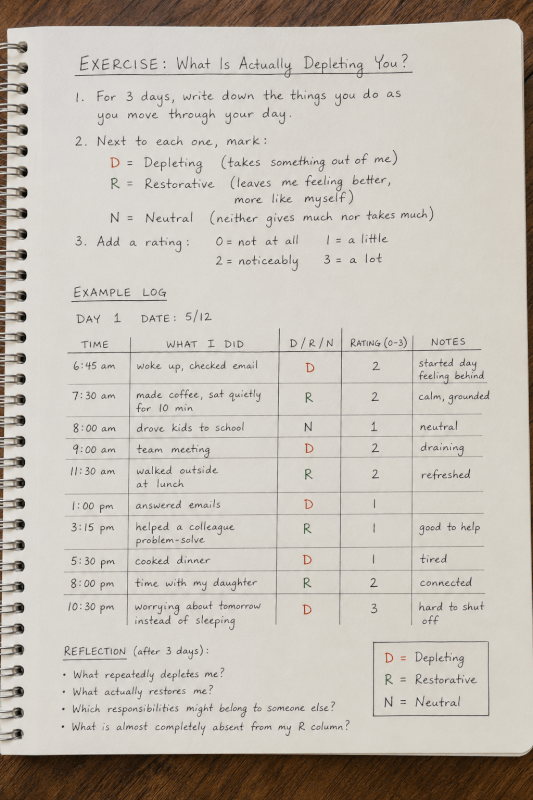
Not sure what’s exhausting you? Track your daily activities for three days and notice what depletes you, restores you, or feels neutral.
Sometimes the answer is obvious.
Your workload is unreasonable. Your child is struggling. You’re caregiving. You haven’t slept properly in months. You are working and carrying most of the household responsibility.
Sometimes it’s less visible.
You aren’t just making the dental appointment. You’re remembering that the appointment needs to be made.
You aren’t just buying the birthday present. You’re remembering the birthday.
You’re anticipating, planning, monitoring, reminding, and keeping track of what needs to happen next.
That mental work counts.
And sometimes being very good at carrying responsibility makes it difficult to recognize when you’re carrying too much. I wrote more about that in Why It’s So Hard to Stop Overfunctioning — Even When You’re Exhausted.
Sometimes the problem isn’t that you haven’t learned to cope effectively enough.
Sometimes too much is actually being asked of you.
Where Are You Depleted?
This question can tell you a lot:
Where does this happen?
Work?
Parenting?
Caregiving?
Everywhere?
I think of another woman who was convinced she was burned out by everything.
But when we looked more closely, that wasn’t quite true.
She still enjoyed dinner with friends. She liked being with her children. She could spend an afternoon gardening and feel surprisingly good.
Sunday afternoon was when everything changed.
By evening, she was already thinking about Monday morning.
That distinction mattered.
She wasn’t depleted by her entire life. Something about work had become profoundly draining.
Someone experiencing work burnout may feel increasingly cynical about work and depleted by the job, but begin to feel more like herself with meaningful time away from it.
Parental burnout is tied specifically to parenting and can include profound exhaustion, emotional distancing from one’s children, feeling fed up with parenting, or feeling unlike the parent you used to be.
Depression may be more pervasive.
Sometimes asking Where do I still feel like myself? tells us as much as asking where we don’t.
Your symptoms don’t always arrive wearing convenient name tags.
What Happens When You Actually Get a Break?
And by break, I mean an actual break.
Not folding laundry while watching Netflix.
Not taking a “day off” to catch up on twelve things.
Not going on vacation and coordinating everyone’s flights, sunscreen, restaurant reservations, emotional states, and passport locations.
One woman couldn’t understand why weekends weren’t helping.
Then she described her weekend.
Saturday morning was groceries, laundry, a child’s activity, returning something to Fred Meyer, meal planning, and answering a few work emails “just to get them out of the way.”
Sunday was cleaning, preparing for the week, making appointments, and getting everyone organized for Monday.
Somewhere in there she took a bath.
She had been counting the bath as recovery.
I am very much in favor of baths.
But twenty-five minutes in warm water cannot reasonably be expected to compensate for forty-seven hours of unpaid project management.
Sometimes rest isn’t failing.
There simply isn’t enough of it.
When you get genuine time away, do you gradually begin to feel more like yourself? Does your energy or interest return?
Or does the worry simply find something new to worry about?
Do you remain flat, exhausted, hopeless, or disconnected even when the original demand is gone?
There isn’t a perfect diagnostic test hidden in these questions.
But the pattern gives you information.
Why Rest Sometimes Doesn’t Fix It
A weekend cannot necessarily compensate for months or years of excessive demands.
And sometimes the conditions creating the exhaustion haven’t changed.
You sleep late Saturday, but Monday’s workload is still unreasonable.
You take a bath, but you’re still carrying most of the household mental load.
You finally stop moving and discover that anxiety becomes much easier to hear when nothing else is competing with it.
None of that means you’re doing rest incorrectly.
Maybe you need more actual recovery time. Maybe anxiety is making it difficult to use the downtime you have. Or maybe something about your workload, relationship, job, or division of responsibility actually needs to change.
Often, several things are true at once.
No amount of meditation makes twenty hours of responsibility fit comfortably into a ten-hour day.
Burnout, Anxiety—or Depression?
There’s another possibility worth talking about.
Some symptoms people attribute to burnout—exhaustion, loss of interest, withdrawal, difficulty concentrating, emotional flatness—can also occur with depression.
Burnout and depression can overlap, and you don’t need to sort this out perfectly by yourself before asking for help.
One useful question is whether the loss of energy or pleasure seems mostly connected to a particular role, or whether it has spread across your life.
If work feels intolerable but you still look forward to seeing friends, painting, gardening, exercising, reading, or whatever usually makes you feel like yourself, that tells us something.
If almost nothing feels enjoyable anymore, your mood is persistently low, you’re feeling hopeless or worthless, or you’re withdrawing broadly from your life, it’s worth being evaluated for depression rather than assuming you simply need a better vacation.
When “Doing Well” Makes It Harder to Notice
One of the strange things about high-functioning anxiety is that many of the behaviors associated with it are rewarded.
You prepare. You remember. You follow through. You anticipate problems. You notice what other people need.
People describe you as dependable.
And being this capable can work extremely well.
Until it doesn’t.
You may be exhausted and still think:
I should be able to handle this.
Or:
Nothing is actually wrong. I’m getting everything done.
That last one is particularly convincing.
But getting everything done tells me that you’re functioning.
It doesn’t tell me what functioning is costing you.
Sometimes the Problem Isn’t Inside You
Women are often encouraged to solve structural problems with personal coping skills.
Your job may genuinely be asking too much of you. Your partner may not be carrying a fair share. Caregiving really is exhausting. Childcare may be inadequate or unaffordable. And some days there simply aren’t enough hours for everything that supposedly needs to fit into them.
Therapy can help with anxiety, perfectionism, guilt, boundaries, and the belief that you should be able to handle everything.
But therapy shouldn’t turn an unreasonable situation into a personal coping problem.
Sometimes the most psychologically healthy realization is:
This is too much.
Then the question becomes what actually can change.
If you recognize yourself as the person who automatically picks up what everyone else leaves behind, When You’re Tired of Carrying Everything: How to Stop Overfunctioning offers some practical ways to begin putting some of it down.
Questions That May Tell You More Than “Am I Burned Out?”
Instead of trying to diagnose yourself from a symptom checklist, consider the pattern.
What is driving me to keep going when I’m tired?
What is actually depleting me?
Where do I feel depleted—and where do I still feel like myself?
When I have genuine time away from the demand, what changes?
Am I exhausted but still worried and mentally “on”?
Have I stopped enjoying things outside the stressful role too?
And perhaps most importantly:
What would need to change—not only inside me, but around me?
You may discover that the answer isn’t anxiety or burnout.
It may be anxiety and exhaustion and too much responsibility.
Human beings are inconveniently resistant to fitting into one checkbox.
Try This: What Is Actually Depleting You?
If you’re not sure what is exhausting you, try collecting some data before you try to fix it.
For three days, write down the things you do as you move through your day.
Don’t make this elaborate. This is not an invitation to create a beautifully color-coded spreadsheet about your burnout.
A note on your phone is enough.
Include the obvious things—work, commuting, making dinner—but also the less visible ones: answering your mother’s worried text, reminding your partner about the appointment, figuring out what everyone is eating, lying awake thinking about tomorrow’s meeting.
Next to each one, mark:
D — Depleting: This took something out of me.
R — Restorative: I felt better, more energized, calmer, more connected, or more like myself afterward.
N — Neutral: It neither gave much nor took much.
If it helps, add a 0–3 rating:
0 = not at all
1 = a little
2 = noticeably
3 = a lot
For example:
Team meeting — D2
Walked outside at lunch — R2
Picked up prescription — N
Twenty-minute conversation with a friend — R3
Spent 45 minutes worrying about an email before sending it — D3
Made dinner — D1
Helped my daughter with something she was worried about — R1/D1
And yes, something can be both.
That may be some of the most useful information you collect.
Helping someone you love can require energy and leave you feeling connected. Challenging work can be tiring and deeply satisfying. Scrolling on your phone may feel like rest while you’re doing it and leave you more depleted afterward.
After three days, don’t immediately make a self-improvement plan.
Just look.
What repeatedly depletes me?
What actually restores me—not what I think should restore me?
Which things are demanding but meaningful?
How much depletion comes from the task itself, and how much comes from worrying, anticipating, monitoring, or trying to do it perfectly?
Which responsibilities might reasonably belong to someone else?
What is almost completely absent from my R column?
The goal isn’t to eliminate everything marked D. Work, parenting, caregiving, relationships, and ordinary life require energy.
The question is whether your days contain a sustainable balance—or whether you’ve built a life with a very impressive D column and are expecting one bath on Sunday to take care of it.
Don’t Assume Persistent Exhaustion Is Psychological
Significant or persistent fatigue, changes in sleep, brain fog, and difficulty concentrating can also have physical causes.
If your exhaustion is new, significant, persistent, or difficult to explain, it’s worth talking with your healthcare provider rather than assuming it must be anxiety or burnout.
Mental and physical health have an annoying habit of occupying the same body.
What Therapy Can Help With
You don’t need to arrive in therapy already knowing whether the right label is anxiety, burnout, depression, perfectionism, overfunctioning, or simply I cannot keep doing this.
You can bring the whole confusing mess into therapy. Figuring out what belongs to anxiety, what belongs to exhaustion, and what belongs to the actual circumstances of your life is part of the work.
Therapy can help you look at what keeps you pushing after you’re depleted, which responsibilities you’ve taken on, and where change needs to happen inside you versus in your actual circumstances.
That might mean responding differently to anxiety, setting a boundary, letting another person carry what belongs to them, or looking at your life and admitting that something has to come off the list.
If anxiety is part of what keeps you going long after you’re tired, you can learn more about my Anxiety Therapy for Women.
If You Want to Experiment on Your Own
The Greater Good Science Center at UC Berkeley is a resource I like for accessible, research-informed information and practices around stress, self-compassion, relationships, resilience, and well-being.
These practices aren’t a substitute for changing an impossible workload, but they can give you ways to experiment with what actually helps you feel restored.
And I emphasize experiment.
If gratitude journaling makes you feel deeply grateful that you can finally stop gratitude journaling, that is also information.
A Final Thought
Maybe the most useful question isn’t:
Am I burned out or anxious?
Maybe it’s:
What is making it so hard for me to stop?
And then:
What is making me this tired in the first place?
One asks you to look at worry, guilt, perfectionism, responsibility, and the pressure to keep functioning.
The other asks you to look at workload, relationships, caregiving, sleep, support, and how much you are actually carrying.
For many women, both sets of answers matter.
You don’t have to become worse at caring, less competent, or mysteriously good at relaxing.
But you may need to stop using the fact that you can keep going as evidence that you should.
Until We Meet Again
Until we meet again — breathe gently, walk slowly, and treat yourself with kindness.
— Iris
If this article resonated with you and you’re considering therapy, you’re welcome to schedule a free consultation.
Research & Sources
World Health Organization. Burn-out an “occupational phenomenon”: International Classification of Diseases. WHO classifies burnout in ICD-11 as an occupational phenomenon rather than a medical condition and defines it specifically in relation to chronic workplace stress that has not been successfully managed.
World Health Organization — Burn-out: an occupational phenomenon
Bundesinstitut für Arzneimittel und Medizinprodukte (BfArM). ICD-10-GM. Germany’s official ICD-10-GM classification includes Ausgebranntsein [Burn-out] under Z73, “problems related to difficulties in coping with life,” rather than classifying it as an independent psychiatric disorder.
BfArM — German ICD-10-GM classification
Ren X, Cai Y, Wang J, Chen O. (2024). A systematic review of parental burnout and related factors among parents. BMC Public Health, 24, 376.
PubMed
Ryan E, Hore K, Power J, Jackson T. (2023). The relationship between physician burnout and depression, anxiety, suicidality and substance abuse: A mixed methods systematic review. Frontiers in Public Health, 11, 1133484.
PubMed