

Reviewed and Updated September 2026 by Iris Hogan, MSW, LICSW
Maybe you’ve had the same exasperated conversation with yourself on one of those tired days. I can’t keep doing this. But almost as soon as you think it, another thought follows: There is no way to stop.
Because if you stop, what falls apart?
That question is part of what makes overfunctioning so difficult. You may know you’re carrying too much and still feel completely responsible for keeping everything going.
If this feels familiar, you may also recognize yourself in High-Functioning Anxiety in Women: Calm on the Outside, Chaos on the Inside, where I write about how anxiety can sometimes look a lot like competence.
What I Mean by Overfunctioning
Overfunctioning isn’t a diagnosis. Maybe it should be.
You become the house manager.
You notice everything that needs to be done. The appointments, the forms, the groceries, the birthday present, the thing that needs fixing, the email nobody has answered yet.
But you’re also keeping track of the emotional landscape of the family. Who is struggling. Who needs encouragement. Who is upset with whom. Who might need a little extra attention today.
And then there is the future.
You’re making plans for what is happening, what needs to happen next, and what might possibly happen three weeks from now.
You anticipate the problem before it becomes a problem and make a plan for that too.
A lot of this is competence. And caring.
The tricky part is noticing when I can do this quietly becomes I should do this, and eventually, If I don’t do this, something might fall apart.
Because somewhere between being capable and feeling responsible for the outcome, you can end up carrying considerably more than your share.
And after a while, it may not even occur to you to ask:
Is this actually mine?
Why Is It So Hard to Stop?
Of course there is a reason you keep stepping in.
You see what needs to be done.
You notice the appointment nobody has made, the permission slip still sitting on the counter, the friend who hasn’t sounded quite right lately, the problem at work that is probably going to become a bigger problem by Friday.
And because you see it, it is very easy to become the person who takes care of it.
You remember when someone else forgets. You step in when someone is struggling. You see a problem coming and think, I could prevent this.
And very often, you can.
That is part of what makes overfunctioning so complicated. A lot of it works.
Things get remembered. Problems get solved. People get taken care of.
But somewhere along the way, I see what needs to be done can quietly become, therefore, it is mine to do.
That’s where I would start getting curious.
Just because I see it, does that make it my responsibility?
And sometimes the problem isn’t that you’ve taken on responsibility that isn’t yours. There really is too much on your plate. Often it’s some of both. That’s a different problem, and simply telling yourself to do less isn’t much of a solution.
Try This: The Responsibility Pie
This is an exercise I like because it makes responsibility a little easier to see.
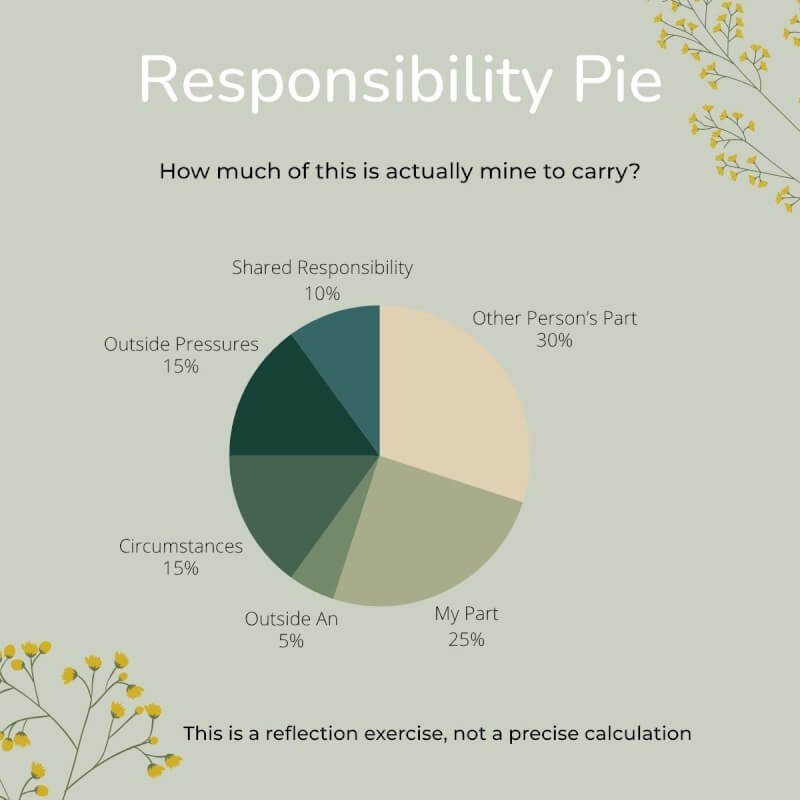
A Responsibility Pie can help you pause and ask: How much of this is actually mine to carry?
Example only. The percentages will be different for every situation.
Think about one thing you are currently worrying about, managing, or trying to make turn out well.
Maybe your teenager is behind on a school project. Maybe your partner has something important they need to remember. Maybe there’s a problem at work and you’ve already started thinking about how to fix it.
Draw a circle.
Now think about everyone and everything that has some responsibility for how this turns out.
If it’s your teenager’s school project, there is your teenager, the teacher, maybe another parent, the school, and the circumstances surrounding the project. You have a piece too, but put yourself in last.
Give everyone and everything a piece of the pie based on how much responsibility actually belongs there. This isn’t precise math. Nobody is checking your percentages.
Then look at your piece. Is that the amount you’ve actually been carrying, or have you quietly been carrying some of the other pieces too?
That can be an interesting moment, because you may realize that you have a role here without being responsible for the whole outcome.
And sometimes your piece really is large. That’s important information too. The point of the exercise isn’t to convince yourself that nothing is your responsibility. It’s to get a more accurate picture of what is.
Now Comes the Hard Part
Seeing that something isn’t entirely your responsibility and actually leaving it with the other person are two different things.
Start with something small. Maybe your partner said they would make the dentist appointment. Your job is to see what happens if you don’t remind them.
That sounds easy enough.
Until Tuesday comes and you realize they still haven’t made the appointment.
Now you’re thinking about it. You know the dentist books out. You could remind them in ten seconds. You may even be slightly annoyed that you have to work this hard not to take care of something that wasn’t yours in the first place.
This is usually the interesting part.
What are you afraid will happen if you leave it alone? And if they do forget, whose problem is that?
Sometimes they will forget. Sometimes something won’t get done. That’s real.
But another person’s mistake doesn’t automatically mean you should have prevented it.
It may simply mean that they get to experience what happens when they carry their own piece of the responsibility pie.
And you get to practice not taking it back.
And Then There Is “Good Enough”
Sometimes letting someone else take responsibility isn’t the hardest part.
Watching how they do it is.
They load the dishwasher differently. They buy the wrong brand. They wait until the last minute. They send the email you would have rewritten three times before hitting send.
Or maybe this isn’t about someone else at all.
Maybe you’re the one who has a hard time doing something at less than your usual standard.
You could order pizza, but dinner could be homemade. The presentation is finished, but another hour would make it better. People are coming over and, although the house is perfectly fine, you find yourself cleaning the bathroom.
There is almost always another 10% available if you’re willing to give it.
The problem is that the extra 10% has to come from somewhere.
So try something deliberately at good enough.
Not something important. Please don’t experiment with good enough brakes on your car.
Pick something ordinary. Send the email. Buy the birthday cake. Leave the laundry in the basket. Serve something for dinner that required remarkably little of you.
You may discover that nobody cares nearly as much as you expected.
Or you may discover that you care.
That’s useful information too.
If doing less feels surprisingly difficult even when you’re exhausted, I wrote more about why in Why It’s So Hard to Stop Overfunctioning — Even When You’re Exhausted.
Somewhere in All of This, Where Are You?
When you spend a lot of time keeping track of everyone else, you get pretty good at it.
You know who needs what. Who is having a hard week. What needs to happen tomorrow. What hasn’t been done yet.
Your own needs can become much less obvious.
Sometimes you don’t notice you’re hungry until you’re suddenly starving. You realize at 3 p.m. that you haven’t really stopped all day. Someone asks what you want to do this weekend and you honestly don’t know.
Not because you don’t have needs or preferences.
You just haven’t been checking in with yourself nearly as often as you’ve been checking in with everyone else.
So every once in a while, turn some of that attention in your own direction.
What do I need right now?
The answer doesn’t have to be profound—or call for a spa day. It may surprise you in its simplicity.
Maybe it’s two minutes of doing absolutely nothing. Maybe it’s getting yourself something to eat that isn’t a kid’s leftover. Maybe it’s asking for help with something you’ve been insisting you can handle.
And other times, maybe it really is the spa day—with or without girlfriends.
Sometimes you know exactly what you need and can’t have it right now. That’s real too.
But there is a difference between not being able to meet a need and not noticing that you have one.
Expect It to Feel a Little Uncomfortable
Doing less can sound wonderful when you’re exhausted.
And then you actually do it.
What sounded so good in your head when you made the decision can suddenly make you cringe with discomfort when you act on it.
You don’t remind your partner. You leave the email until tomorrow. You let someone else handle something without checking how they’re handling it.
And now you’re thinking about it.
Maybe you feel guilty. Maybe you worry that you’re being selfish or irresponsible. Or maybe you’re simply irritated because it would be so much easier to take care of the thing than to sit there watching it not get done.
That discomfort can pull you right back into the old pattern.
This is where it can help to wait a little before deciding that you need to act.
You don’t have to convince yourself that everything will be fine. You don’t know that.
Instead, ask yourself: Does something actually need my attention right now, or am I uncomfortable because I’m not taking care of it?
Those aren’t always the same thing.
And if you decide that it really does need your attention, you can step in.
The goal isn’t to become someone who never helps. It’s to have a little more choice about when you do.
What Change Can Look Like
Change here may be pretty ordinary.
You still notice what needs to be done. You probably always will. The difference is that noticing something doesn’t automatically mean you have to take care of it.
You might catch yourself halfway through reminding someone and stop. You might let another person solve a problem before offering your solution. You might decide that what you already did today was enough, even though there are still things on the list.
And sometimes you’ll take over anyway.
This isn’t something you have to become good at overnight. In fact, turning not overfunctioning into one more thing you need to do perfectly would be rather missing the point.
What you’re practicing is noticing something that needs attention and giving yourself a moment to decide whether it actually needs your attention.
Sometimes it will. Sometimes it won’t. The change is that you get to decide.
Therapy Can Help You Look at What Keeps You Carrying
Sometimes you can begin making these changes on your own. And sometimes you keep finding yourself back in the same place—taking over, worrying, anticipating, and feeling responsible for far more than your share.
Therapy can be a place to get curious about that.
Anxiety or perfectionism may be part of it. Maybe you learned a long time ago that being capable was important in your family. Or perhaps your life has required you to be the person who keeps things going for so long that you aren’t quite sure what doing things differently would even look like.
There isn’t one explanation for overfunctioning, and understanding where yours comes from can help you figure out what actually needs to change.
If anxiety, worry, perfectionism, or the pressure to keep everything together is taking up more of your life than you want it to, you can read more about my approach to Anxiety Therapy for Women.
And when earlier experiences or trauma are part of what keeps the pattern going, EMDR Therapy for Women may also be worth exploring.
I don’t think the goal is to become less competent.
If you’re someone who notices things, gets things done, and takes good care of people, you may genuinely like those things about yourself.
You don’t need to stop being that person. But perhaps you don’t have to be that person quite so much of the time.
The next time you notice something that needs to be handled, see if you can give yourself a moment before stepping in. It may be yours to take care of.
And it may not be.
Either way, you get to decide.
Until We Meet Again
Until we meet again — breathe gently, walk slowly, and treat yourself with kindness.
— Iris
If you recognize yourself in this and would like support with anxiety, perfectionism, or the pressure of always holding it together, you’re welcome to schedule a free 15-minute consultation.
Research & Sources
Reich-Stiebert, N., Froehlich, L., & Voltmer, J.-B. (2023). Gendered Mental Labor: A Systematic Literature Review on the Cognitive Dimension of Unpaid Work Within the Household and Childcare. Sex Roles, 88, 475–494.
Read the full article
Callaghan, T., Greene, D., Shafran, R., Lunn, J., & Egan, S. J. (2024). The relationships between perfectionism and symptoms of depression, anxiety and obsessive-compulsive disorder in adults: a systematic review and meta-analysis. Cognitive Behaviour Therapy, 53(2), 121–132.
PubMed
Wilson, E. J., Abbott, M. J., & Norton, A. R. (2023). The impact of psychological treatment on intolerance of uncertainty in generalized anxiety disorder: A systematic review and meta-analysis. Journal of Anxiety Disorders, 97, 102729.
PubMed
Galloway, R., Watson, H. J., Greene, D., Shafran, R., & Egan, S. J. (2022). The efficacy of randomised controlled trials of cognitive behaviour therapy for perfectionism: a systematic review and meta-analysis. Cognitive Behaviour Therapy, 51(2), 170–184.
PubMed
Psychology Tools. Pie Chart – Responsibility. A CBT-informed exercise for examining and redistributing perceived responsibility for an outcome.
Responsibility Pie Chart