

By Iris Hogan, MSW, LICSW
Reviewed and updated September 2026
You remembered the lunch, the water bottle, and the permission slip.
You forgot it was Pajama Day.
And there it is.
How did I forget that? Everyone else remembered. I really need to get more organized.
Never mind that you got everyone out the door, remembered the permission slip, found the missing shoe, and managed to locate a reasonably clean water bottle at 7:42 in the morning.
Pajama Day has entered the evidence.
This is one of the strange things about mom guilt. We can do twenty things reasonably well, but somehow the one thing we forgot or wish we had done differently is what we get stuck on.
Sometimes that guilt is useful. Sometimes there really is something we want to repair or change.
But often the feeling becomes much bigger than the thing that actually happened.
I forgot Pajama Day becomes I can’t keep anything together.
I lost my patience becomes I’m a bad mom.
I ordered takeout again becomes I should be doing better than this.
Often, the problem isn’t that you’re not doing enough. It’s that the list of things you could be doing is perpetual and ever-expanding. There is no finishing it.
The To-Do List You Can Never Finish
You make the dentist appointment and remember that somebody needs new shoes. You answer the school email and another one arrives. You figure out dinner and remember that you haven’t registered for camp.
And then there are all the things that aren’t actually written on the list.
Am I spending enough time with them?
Am I listening enough?
Should we be eating better?
Am I on my phone too much?
Maybe you notice that one of your kids seems quieter than usual and wonder if you need to check in.
None of these are unreasonable things to care about. That’s part of what makes this so hard.
There will always be something else you could do.
And yet we keep using what remains undone as evidence that we aren’t doing enough.
Research on the mental load of family life has begun to put language around some of this invisible work — the anticipating, remembering, planning, and monitoring that keeps a household running. A systematic review found that women tend to carry a larger share of this mental labor, particularly around childcare and parenting decisions, and that carrying more of this work is associated with greater stress and lower well-being.
Read the systematic review on gendered mental labor in households and childcare.
For some women, that constant sense of responsibility also overlaps with anxiety. It can be especially hard to recognize when anxiety looks less like panic and more like trying very hard to get everything right.
Related: Why Postpartum Anxiety Isn’t Always Obvious
Before You Decide You’re a Bad Mom
When mom guilt shows up, start by naming what actually happened.
I lost my patience this morning.
Not: I’m a bad mom.
I forgot Pajama Day.
Not: I can’t keep anything together.
I was on my phone while my child was talking to me.
Not: I’m never present.
One tells us what actually happened. The other tells us what we think it means about us.
Before you’re ready to hand down that verdict, ask the jury.
What would other mothers — women who know what it is actually like to raise children — say about how you are showing up?
Would they hear that you lost your patience after a terrible morning and conclude that you’re a bad mother?
Or would they say, Yep. Been there.
Normalizing our behavior doesn’t mean that anything goes. Sometimes we need to apologize, repair, or make a change.
It means we can let a mistake be a mistake without making it mean something much bigger about who we are.
When the Not-Good-Enough Voice Keeps Going
But what if you’ve looked at what happened, made a repair if one was needed, and the not good enough voice keeps going?
Your mind can offer another argument, followed by a counterargument, and then circle right back to where it started.
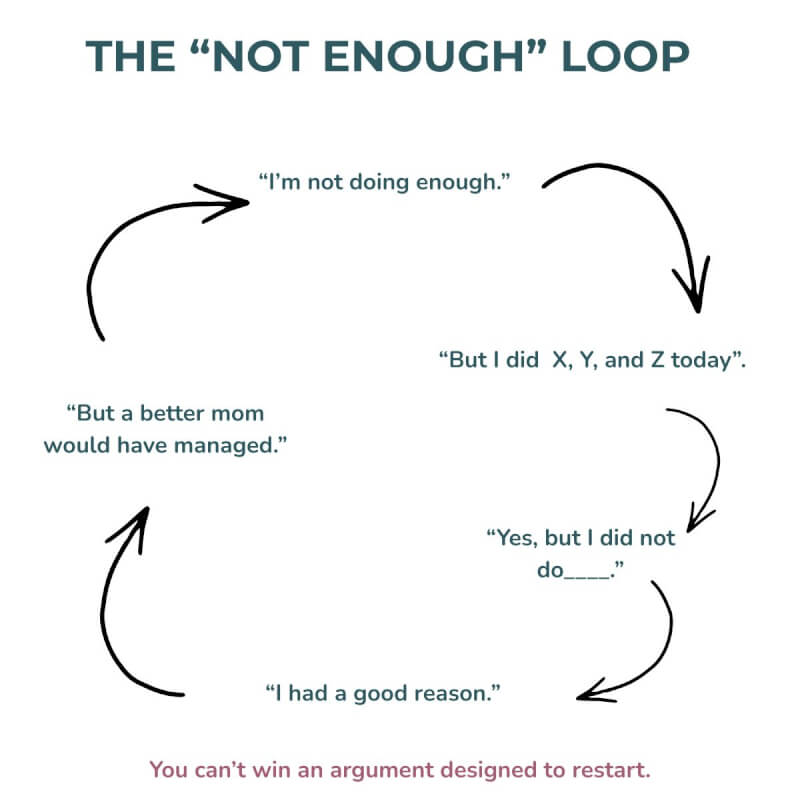
Maybe we don’t need to win it.
Maybe there is no winning the argument that you are not enough. Maybe we have to find ways to step out of the game.
Instead, try asking:
What value is this voice trying to help me connect with?
Underneath I’m not a good enough mom may be something much simpler:
I really want to be a good mom.
I want to be present.
I want my kids to know they can count on me.
Sometimes underneath all that criticism is something that really matters to us.
Then ask:
What would be good enough here?
Because there is no natural finish line.
If being connected to your children matters to you, there will always be more you could do. You could listen longer, be more patient, put your phone down more often. There is always something.
At some point, we have to decide what is enough, because the list isn’t going to decide for us.
Maybe good enough today is ten minutes of really listening.
Maybe it’s making the appointment you’ve been putting off.
Maybe it’s apologizing for how you handled this morning.
And maybe it’s ordering pizza and sitting down because you’re exhausted.
You don’t have to stop caring about being a good mom.
You just have to stop requiring yourself to prove it.
What If There Is Just Too Much?
Sometimes the problem isn’t how you’re thinking about the list.
The list is actually ridiculous.
Someone has to remember the school email, the pediatrician, the permission slip, dinner, the shoes that don’t fit — and apparently tomorrow is Crazy Hair Day.
If most of that belongs to you, this isn’t simply a matter of learning to manage your guilt better.
You may need less to carry.
Maybe you have needs that can’t keep being pushed aside. Maybe you are tired because there really is too much. Maybe something has to change.
Research on cognitive household labor supports the idea that this work is not trivial. A study of mothers of young children found that mothers carried more of the overall domestic labor than their partners and that the division was particularly unequal for cognitive labor — the planning and anticipating involved in keeping household tasks moving. Greater cognitive labor was associated with stress, burnout, depression, overall mental health, and relationship functioning.
Read the study on cognitive household labor and maternal well-being.
That can mean deciding what doesn’t actually need to happen. What can wait. What another adult can own — not “help with,” but actually own.
And sometimes it means looking at something on your list and asking a question we don’t ask nearly enough:
Does this actually need to be done?
Sometimes the answer isn’t figuring out how to manage everything better.
It’s having less to manage.
If you recognize yourself as the person who keeps carrying more because putting something down feels almost impossible, you may also find Why It’s So Hard to Stop Overfunctioning – Even When You’re Exhausted helpful.
Mom Guilt Is Not a Measure of How Good a Mother You Are
Maybe the goal isn’t to eliminate mom guilt.
Start by noticing what actually happened — not your interpretation of what it says about you.
Then ask yourself about your intentions. What were you trying to do? What matters to you here?
Maybe give yourself the grace to assume good intentions — and name them.
I want to be a good mom.
I want to be there for my kids.
I want to get this right.
And finally, decide what will be good enough in this imperfect world.
Because the to-do list isn’t going to make that decision for you.
Until We Meet Again
Until we meet again — breathe gently, walk slowly, and treat yourself with kindness.
— Iris
Research & Sources
Reich-Stiebert, N., Froehlich, L., & Voltmer, J.-B. (2023). Gendered mental labor: A systematic literature review on the cognitive dimension of unpaid work within the household and childcare. Sex Roles, 88, 475–494.
Aviv, E., Waizman, Y., Kim, E., Liu, J., Rodsky, E., & Saxbe, D. (2025). Cognitive household labor: Gender disparities and consequences for maternal mental health and well-being. Archives of Women’s Mental Health, 28(1), 5–14.